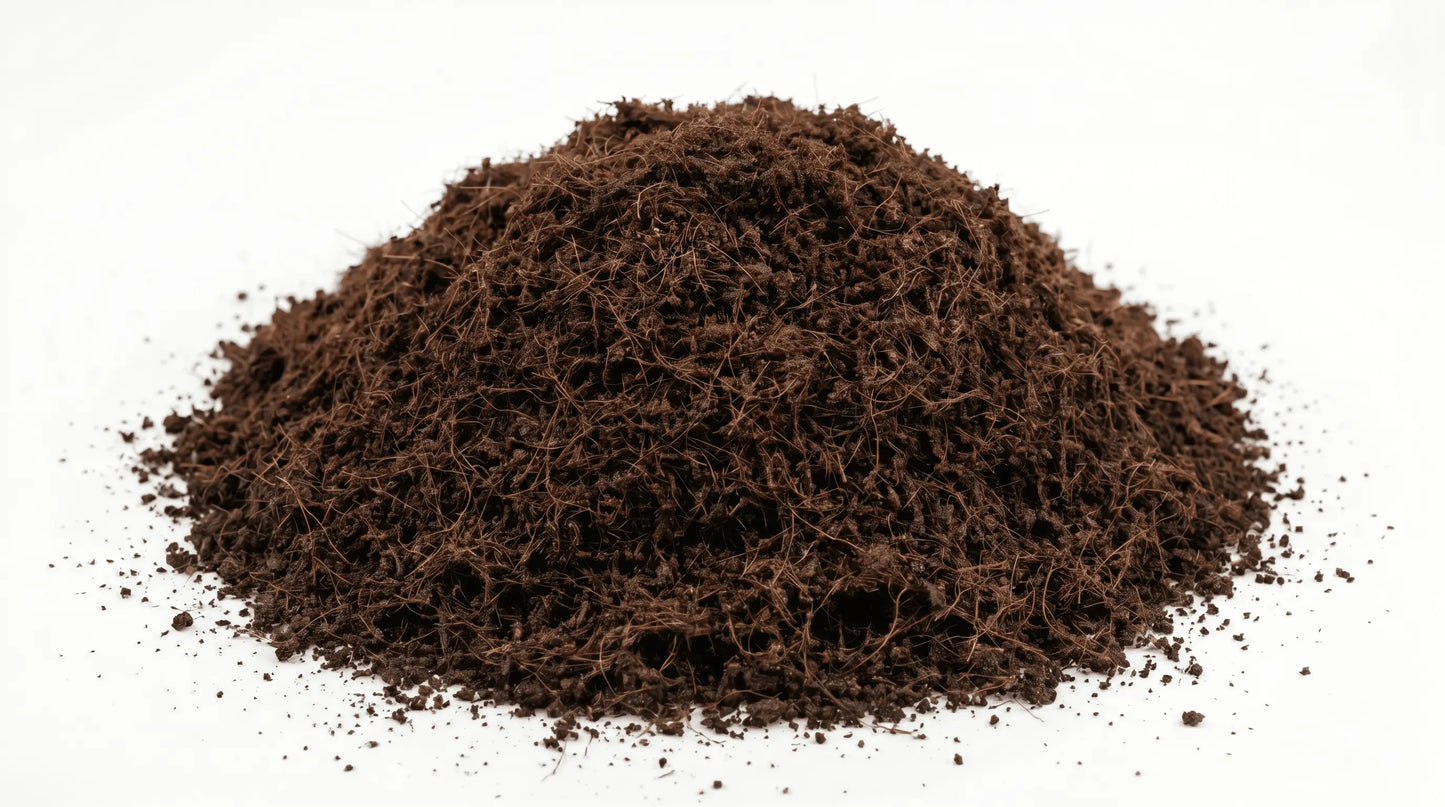
Organic Coco Coir Mushroom Substrate
Organic Coco Coir Mushroom Substrate
Couldn't load pickup availability
- Secure Payment
- Discreet Shipping
- Worldwide Shipping
Coco Coir Substrate – The Standard Bulk Substrate for Cubensis Monotub Grows
Our Coco Coir Substrate brick is the go-to bulk substrate for cubensis cultivation. Just add boiling water, let it hydrate and cool, mix with your colonized grain spawn, and layer into your monotub. No pressure cooker, no sterilization, no complicated prep.
How to Use Coco Coir Substrate in a Monotub
Once your grain spawn jars are fully colonized, hydrate the coco coir brick and mix it with your spawn at a ratio of roughly 1 part spawn to 3 parts substrate. Pack evenly into your monotub, seal it up, and let the mycelium finish colonizing the bulk layer before switching to fruiting conditions.
The low nutrient content of coco coir keeps contamination rates low while still giving your mycelium a moisture-rich environment to colonize and fruit from.
Why Growers Use Coco Coir for Monotubs
Coco coir is one of the most popular bulk substrates for cubensis monotub grows because it is forgiving, consistent, and easy to prepare. It holds moisture well without becoming waterlogged, has a naturally neutral pH, and does not need to be sterilized. For beginners, this removes one of the most common failure points in the grow process.
How to Prepare Your Coco Coir Substrate Brick
What you need:
- 1 Coco Coir Substrate brick
- Boiling water
- Large bowl or bucket
Step 1 - Hydrate the brick Place the brick in a large bowl. Pour boiling water over it and break it apart as it softens. Use roughly 3 to 4 liters of boiling water per brick.
Step 2 - Cover and pasteurize Stir well until fully broken up. Cover the bowl with a lid or foil and let it sit for 1 hour. The heat passively pasteurizes the substrate.
Step 3 - Check field capacity Let it cool to room temperature. Squeeze a handful firmly. You want just a few drops to come out. If it drips heavily, let it dry a little longer before using.
Step 4 - Mix with colonized grain spawn Once cooled, mix with your colonized grain spawn and layer into your monotub.
CVG-Calulator: Check out our cvg-calculator for the perfect substrate mix.
Substrate Specifications
| Detail | |
|---|---|
| Type | Pure Coco Coir |
| Form | Compressed Brick |
| Sterilization needed | No |
| Preparation | Boiling water method |
| Best used for | Cubensis Monotub |
| Mix ratio | 1 part spawn to 3 parts substrate |
Frequently Asked Questions
Do I need to sterilize coco coir? No. Hydrating with boiling water and letting it sit covered for an hour is sufficient preparation. No pressure cooker needed.
Can I mix coco coir with vermiculite? Yes. Many growers use a 50/50 coco coir and vermiculite mix. The vermiculite improves water retention and air exchange in the substrate. Our brick works well with this method.
How much does one brick make? One brick expands significantly once hydrated and typically fills a standard monotub when mixed with grain spawn.
Can I reuse the substrate after a harvest? Some growers reuse their substrate for a second or third flush by rehydrating and maintaining humidity. Results vary depending on contamination levels after the first harvest.
1. What Is the Perfect "Field Capacity" for Plain Coco Coir?
1. What Is the Perfect "Field Capacity" for Plain Coco Coir?
Field capacity is the ideal moisture level. For plain coco coir, the perfect starting ratio is 1:5 (coir to water) by weight.
For example, for a 300g block of coir, you would use 1500ml of boiling water. This ratio will get you to a perfect field capacity almost every time.
2. Do I Need to Add Vermiculite and Gypsum (CVG)?
2. Do I Need to Add Vermiculite and Gypsum (CVG)?
No, you don't. Mushrooms grow wonderfully on plain coco coir. We actually recommend plain coir for first-time growers because it is simple, effective, and gets you fantastic results. You can always experiment with additives later.
3. Do I Have to Sterilize the Coco Coir?
3. Do I Have to Sterilize the Coco Coir?
No, you only need to pasteurize it. You do not need to sterilize coco coir. This is because coco coir is naturally resistant to mold and bacteria, so full sterilization is not required. Simply adding boiling wat is the easiest way to pasteurize it.
4. How Long Must the Coir Cool Down After Pasteurizing?
4. How Long Must the Coir Cool Down After Pasteurizing?
This is a critical step. We recommend you wait at least 6 hours for the substrate to cool down to room temperature (below 29°C / 84°F).
If you add your mycelium while the coir is still warm, the heat can kill it and your project will fail.
5. How Much Hydrated Substrate Will I Get from One 300g Block?
5. How Much Hydrated Substrate Will I Get from One 300g Block?
A single 300g compressed block of coco coir will expand to approximately 3.5 to 4.5 liters perfectly hydrated substrate once you add water.